Monday, November 19, 2012

The Power of Fallacies


It is very interesting how George Orwell’s essay Shooting an Elephant contain various fallacies. Fallacies are fundamental in all speeches and essays. I’m guessing the reason is because all of these have rhetoric. Most of the writing we have access to has the direct or indirect intention to manipulate the audience’s minds.

 At the beginning of his essay, Orwell uses the all-natural fallacy, he is assuming that all officer have the same trait. He says “as a police officer I was an obvious target and was baited whenever seemed safe to do so.” Here he is assuming that all police officers are targets. The fact that part of the population sees the policemen as a possible object for their principals doesn’t mean that all of it does. Orwell is exaggerating. This is all a strategic way of manipulating the authors mind with the use of fallacies and rhetoric.

Orwell, I thought you respected more your audience. The deception! The way you closed your essay is not kind at all. Killing an elephant has a lot of consequences; don’t try to feel good only because you want a way out. Yes, the elephant hared the population and for a moment cause chaos to the community, however this doesn’t make your actions reasonable. I know that in the moment you thought about this but you didn’t care. You were pushed by the community to kill it so you had no way out. Still, this pressure doesn’t take away the actions of the owner. Referring the owner as “only an Indian” is offending. Here you are using the fallacy of ignorance. You are assuming that since it is an Indian your act will have no consequences. Don’t be so ignorant, think in others as well the fact that “the Indian” is poor doesn’t mean that you can refer to him like that.

Ultimately, we can see how the authors sometimes use modes of rhetoric to manipulate the audience. These modes also persuade to make a closer relation with the reader. The use of fallacies is seen in all pieces of writing. Now,  I’m an expert identifying this incorrect reasoning the author makes to manipulate and persuade us.   

Thursday, November 15, 2012

Gandi, The King of Fallacies


After reading Gandi’s famous speech called Kingsley Hall, I felt a close connection to this hero. He is one of the most important persons that have ever steeped in this world. His thoughts promote leadership and the want of changing the world.

Throughout his speech there is an internal happiness that start to flourish. His words inspire me and create a want of going outside and changing the world.

As a started reading the speech I couldn’t spot the fallacies that quickly as I thought I would. But I followed Emiliana Pacheco’s advise of reading it over and over again. Referring to her blog I was able to understand what I was supposed to do.

This incorrect reasoning is present in all written piece. For the piece to be interesting this reasoning have to exist.

For example in Gandhi’s speech had a lot of hidden fallacies. The ones I could identify were the following. At the beginning he starts to ask a lot of questions, “even in ordinary affairs we know that people do not know who rules or why and how He rules and yet they know that there is a power that certainly rules.” Here he is making the fallacy of many questions. He is also using the fallacy of antecedent. While he is saying that people don’t know who rules, he remarks the fact that God rules people. So they actually do know who rules them. Also he is using the fallacy of tautology the proof and the conclusion is the same thing. He starts saying that people don’t know who rules them. Then he says that “He” rules (referring to God) and then he concludes his sentence saying that this power has certain rules. Here I make a connection with Heinrichs which said “ [that a] proof [will] agree with the conclusion perfectly… creating a tautology” (146). Wow! Three in one, I didn’t even think that would be possible.

Afterward he starts talking of this village called Mysore. He talks about who rules it and who people think it rules it, arriving to the conclusion that God is the one, “king of kings.” This phrase is also the fallacy of tautology since Gandhi is repeating the premise.  
As I continued to read it became easier to find this fallacies in the million of sentences. Gandhi continues to repeat the fact that people know who is ruling them, “there is a alterable law that governs everything and every being that exists of lives.”

Gandhi thankyou, now we know clearly who rules the people.


Zzzzzzz….good night. 

Tuesday, November 13, 2012

Play The Game


After learning all of Heinrichs techniques of attacking he enriches our knowledge with some of the tricks for defending ourselves.

After reading that blank sheet of paper that has big capital letters saying DEFENSE I was shocked. This word can cause to types of feelings while reading. One is a tremendous shock of not knowing what will come and the other one is a big relief of knowing everything will be all right because we know how to defend.

Knowing the point of the opponent can help persuade your enemy. As I said on my previous blogs, an argument is not about winning or losing, is about convincing. If I know how the opponent feels with my arguments I know how to attack and to persuade all the points of the argument.
All the advertisements do is play ticks on you. They manipulate your mind to make you feel that their product will satisfy all your needs. 

For example, in this commercial of Clorox, the fat lady knows she made a mistake telling the other lady she was pregnant. To make the moment less awkward she just through the glass of wine in her shirt . With this she has an excuse to walk away.  The commercial has two goals,  first of all make you laugh and second make you think that with Clorox that big stain will go away. In this moment you feel a connection and this convinces you to buy this Clorox. Here the creators are creating a connection with those you suffer with stains. Without knowing the audience they just manipulate their minds and make them buy this detergent.

Thanks to Heinrichs knowledge and rich ideas one can detect these techniques. Clorox may be a very good detergent, but also think about the exaggeration and the company’s goal. They want to make you buy that product; therefore they will make everything to convince you. Here is where “comparable experience stands” (187). Sometimes we as buyers let ourselves convince form the sellers and from the advertisement techniques. To avoid this to happen Heinrichs provides a set of examples and explanations. These will help the audience know how the companies play on us as buyers.  

Relax


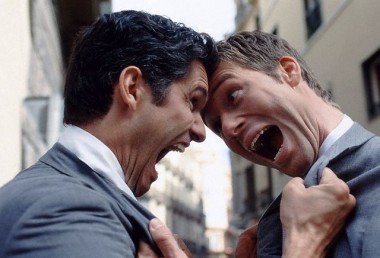
Today I realized something. Most of the arguments end up in a terrible fight. Most of the people don’t know how to argue and pretend to do so.

Heinrichs points put a very interesting point. He states that if one argues to win then the argument will end up in an argument. He states that  “the purpose of the argument is to persuasive, not correct” (156).

He also talks about illogic thinking. To convince your opponent one has to try all the tips he has showed us. However one has to know when to use them. Some of the time when you identify fallacies one can end in a fight. Rather than identifying them one has to show the ways to trick your opponent and come up with an intelligent come back.

In this video, Candace (the girl) just tries to offend Phineas. Candace goal while saying “sucked into a videogame” was to offend him. Phineas decided to ignore that part of the offense and just take it as a brilliant idea for the day. They would get sucked into a videogame!

Sometimes you just have to let things pass. Like Phineas, he just ignored her sister and continued his day. He used his sister “offense” to create a plan that will make his day more interesting and fun. This is what Heinrichs calls the inarguable. This comment was just random, however if he had start to argue then it would of turned into a illogical fight.

In this chapter Heinrichs clearly states: “in most cases there is no right or wrong decision in an argument” (157). In other words one has to go with the flow, not stressing about what is right of wrong. My mother always tells me en la guerra y en el amor todo se vale. Arguments are more like a war of words; the one that convinces better using rhetorical tricks wins. 

Tuesday, November 6, 2012

"A Fool May Talk, but a Wise Man Speaks" - Ben Jonson (121)


While arguing one has to treat the audience as grownups. Is easier to convince your opponent with facts and real life statistics. This is what arguing is all about.

Lets pretend I am arguing about a specific topic. If my opponent attacks me with facts and real life statistics then I will be convinced at that exact moment. For example, I am arguing with my mom about going with my boyfriend to a party. I will attack her with a lot of facts such as, my grades, my birthday present and facts like that that will help me get what I want. With this she will be convinced.
When Heinrichs says that philosophy is boring, he is contradicting himself. Through out the book all his facts and sources are from philosophers, so saying that they are boring does not make a lot of since. However he uses to defend rhetoric. He says that “rhetoric is much less boring. While philosophy scorns public opinion, in rhetoric, the audience’s beliefs are at least as important as fact” (123). This is true; in order to be a good arguer you don’t have to know all the facts. One has to know only how to attack your opponent and identify their weak points, like this one can manipulate their minds.
I like the theory of ‘if-then’ (125). This is a better way of going out of an argument. By using this theory one can easily persuade the opponent without forming a big deal. This is called enthymeme. Here is an example:
            Blond girls are dumb.
            Anastasia has blond hair.
            Then Anastasia is dumb.
Other way of attacking could be by logic. There are two kinds of logic: deductive and inductive logic. This two logics help you while arguing. While deductive logc start from a “common place” (133), inductive logic start “with the specific and moves to general” (133). This two logic work. When you are not sure about having a common place with your opponent then you use inductive logic.

For example, in this commercial, they are convincing you to buy Bratz doll. This doll comes with a diamond for you. They say that if it is not true they will refund the money. Therefore you feel secure of buying the piece. The creator employs logos telling you a fact that will make you feel confidence in buying the doll.  

Fact, comparison and story telling is another way of convincing. When talking to your opponent you have to give one situation for each.
For example:
Me: I want to go to Cartagena alone with my friends.
Fact: I have been alone in Europe in a summer school and everything turned up perfectly.
Story: a friend of mine went with his parents and he did everything to escape, he escaped and someone drugged him.
Comparison: the children that have all the freedom are the more responsible ones, instead the ones that have pressure from their parents, when they feel a little of freedom they do horrible things.
So trust me!
Thanks to Heinrichs I can now use this techniques in convincing my parents. 

Thursday, November 1, 2012

Play, the Game!


Playing with the definition of words is a very interesting. If someday you want to change the opponent’s argument, the use of definitions will help. By using the definition I don’t mean the exact definition of the dictionary, I mean the connotation. The one we know from common sense. This is a very fun game to play with the opponent. This tip is a thing I will use in my every day life. By saying the definition we can impress the audience giving them a good impression of what we are trying to say.

By using definitions we are playing with the comebacks of the opponent. If the comeback benefits our argument then it is useful, if not then, contradict what the opponent said by using some of his ideas. If the opponent is one that uses fancy words then adapt to these words and base your argument in these. This will leave the opponent struggling on what to respond. However, “make sure  [that] the definition you start with work in your favor” (112). This trick can also work against your argument so one has to be careful when using it.

Heinrichs tips are very interesting. He talks in page 119 about some techniques that we use unconsciously. Which are:


  • ·      Term changing
  • ·      Redefinition
  • ·      Definition jujitsu: if you opponent’s terms actually favor you, use then to attack.
  • ·      Definition judo: use terms that contrast with your opponent’s, creating a context that makes them look bad. 


This are things that we use while talking to our friends, parents or teachers. Some persuaders are very good in using these techniques. They use them in a way that nobody notices. With these four techniques we may leave our opponent with no comeback, therefore leaving you as the winner of the argument.

While reading this chapter I noticed that while arguing we see our opponent as our enemy. The way Heinrichs gives ways to leave the audience with no words is sometimes aggressive. But, if being aggressive means winning the argument then we are all aggressive.


Sunday, October 28, 2012

Always Act Normal


Acting natural is the key for being a good persuader. Giving the audience confidence while arguing is very important.

Acting as a normal person and speaking normally is fundamental. Starting an argument with a very calm voice and throughout the argument gain some power and volume is something I learned in this chapter.

According to Aristotle, it is very important to be disinterested while arguing. Lets have a hypothetical situation in which I want to go to a party. Convincing my parents is very difficult because this party is for grownups. According to Heinrichs, the thing I must do to convince my parents is show some disinterest. For example, “mom, this weekend I have a party, but I am not willing to go. I will stay sometime in my house, doing homework and being alone, while my friends are having lots of fun! I am very responsible.” After this my parents will feel sorry about my situation therefore they will give me permission.

Surprising the audience is very important. Starting an argument very discrete and talking honest gains attention. According to the Spaniard, Quintilian “a speaker might choose [to pretend to be] uncertain [and this] will make him appear [as an] honest man” (75). As part of the audience I prefer a man that is honest than one that is always talking according to theory. Here is a simpler way to understand it: “don’t be tricky, seem to be in doubt about what to say” (75). This technique is called dubitation.
Dubitation has a lot of power while convincing. Using this theory may help a lot speakers, leaving them with an advantage over their opponent. Ethos plays a very important roll in an argument. Your character is the key for convincing the audience that you are right. Being secure about what you are saying helps your argument making it strong. The personality is very important, Heirichs says that “in an argument, you don’t rest on your personality and reputation, you perform them” (77).  At the end having an argument is like acting a scene, where the best “actor” will be the one that convinces the audience that their point is the right one.
 In Quintilian's I didn’t understand the word feign.
Feign: (verb) to pretend or to be affected by.